


 By Aiden Armstrong
The current estimated AI medical coding market is at USD 3.41 billion, with forecasts reaching $10.84 billion by 2034 at a 13.76% compound annual growth rate, as noted by Fortune Business Insights. For hospital executives, the more important signal is not market size. It is the operating pressure behind that growth.
Autonomous medical coding and auditing services are gaining traction because the economics of manual coding have changed. Labor shortages raise unit costs. Documentation requirements increase time per chart. Retrospective audits catch errors after claims have already affected cash flow, denial rates, and repayment risk. In that environment, coding is no longer a back-office productivity issue. It is a revenue integrity control point.
That distinction matters at the leadership level.
A hospital that treats autonomous coding as a narrow automation purchase may reduce some manual effort and still miss the larger opportunity. A hospital that approaches it as an operating model change can improve coding turnaround time, strengthen audit coverage, reduce avoidable denials, and create clearer accountability for financial outcomes. The difference usually comes down to governance, baseline measurement, and partner selection.
This guide focuses on those executive decisions. It examines how the technology works, where ROI is realized, how compliance oversight should change, and what criteria matter when choosing a long-term partner. Those are the factors that determine whether autonomous coding becomes a controlled source of margin improvement or another underused tool inside the revenue cycle.
The Tipping Point for Revenue Cycle Management
Coding errors rarely stay in the coding department. They surface later as slower cash posting, denials, audit findings, and disputed reimbursement. For hospital leadership, that changes the decision frame. Coding is no longer a downstream production task. It is an operational control point that affects revenue integrity, compliance exposure, and the cost to collect.
That shift is being driven by persistent pressure across the revenue cycle. Staffing gaps lengthen turnaround times. Documentation requirements increase the effort required per chart. Payer edits and retrospective reviews raise the cost of coding variation. As noted earlier, those forces are driving adoption of autonomous coding. The strategic question for executives is not whether automation is gaining traction. It is whether the organization will treat it as isolated software or as part of a governed RCM redesign.
Why coding has moved into the C suite
Each member of the leadership team sees a different part of the same problem.
A CFO sees coding in days to bill, net revenue variance, and avoidable write-offs. A COO sees capacity limits, handoff delays, and the operational drag of manual exceptions. A chief compliance officer sees inconsistent traceability, limited audit coverage, and increased repayment risk when documentation support is weak. Viewed together, those are not departmental concerns. They are enterprise performance issues.
Autonomous medical coding and auditing services deserve executive attention because they can change how hospitals control these risks. A well-implemented platform can standardize code assignment, route uncertain encounters for review, and expand audit coverage beyond small retrospective samples. Hospitals evaluating autonomous coding technology for revenue cycle operations should assess it with the same discipline used for other margin-sensitive infrastructure decisions.
Three conditions usually create the tipping point:
- Coding complexity is outpacing manual capacity: More encounter variation and payer-specific nuance create more room for inconsistent outcomes.
- Labor constraints are affecting throughput: Specialized coders and auditors remain difficult to recruit, train, and retain.
- Financial performance is becoming more sensitive to small defects: Minor coding inconsistencies can delay claims, reduce reimbursement, or increase denial and audit rework.
Hospitals that postpone modernization often absorb the cost indirectly. The impact shows up in A/R, late-charge correction, denial appeals, and remediation work that consumes experienced staff.
The strategic reframing
The highest-performing organizations do not evaluate autonomous coding as simple labor substitution. They evaluate it as a control system embedded in the middle of the revenue cycle.
This distinction is critical for capital planning and governance. A narrow automation purchase may reduce manual touches on straightforward charts. It usually does little to improve accountability, exception handling, audit readiness, or financial predictability. An enterprise RCM investment is different. It starts with baseline metrics, defines escalation rules, assigns ownership for model oversight, and ties performance to measurable outcomes such as coding turnaround time, denial reduction, audit yield, and cost per claim.
That is the decision framework hospital leadership needs in 2026. The technology itself matters, but governance determines whether it produces durable margin improvement or becomes another underused tool.
Decoding the Technology Behind Autonomous Coding
Autonomous coding sounds opaque until you break it into functions. In practice, the technology behaves like a coordinated team.
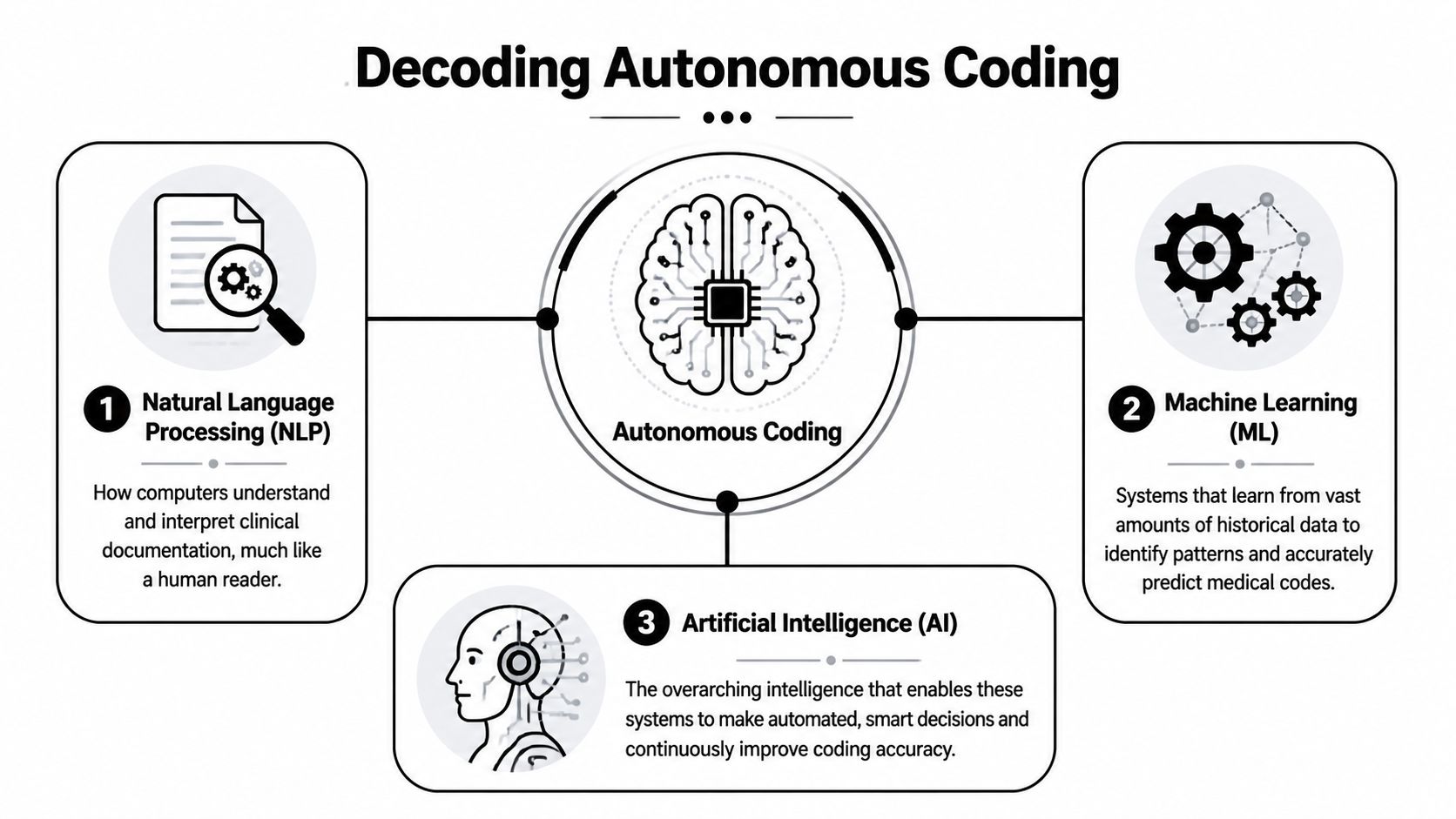
Natural Language Processing, or NLP, reads clinical documentation. Machine Learning recognizes patterns from historical coding and adjudication outcomes. Artificial Intelligence orchestrates the decision logic, ranking likely codes, identifying missing support, and deciding which charts can move forward and which should go to human review.
How the engine actually works
Start with NLP. Think of it as the part of the system that can read a physician note, operative report, discharge summary, lab results, and problem list without needing each fact to be entered into a neat field. It interprets structured and unstructured data together.
Machine learning sits behind that reading layer. It helps the platform determine which findings usually support which code combinations, where documentation tends to be incomplete, and which encounter types are more likely to require escalation.
AI is the coordinator. It weighs the available evidence, applies coding logic, and produces either a code set, a confidence-driven recommendation, or a routing decision.
A capable platform doesn’t stop at extraction. It also has to map evidence to coding rationale in a way an auditor can follow. That’s why organizations evaluating platforms often look closely at workflow transparency, not just code assignment speed. A practical example of this model appears in GeBBS autonomous coding technology, which describes how automation is embedded into coding workflows rather than treated as a standalone suggestion tool.
Why newer systems outperform older CAC tools
Older computer-assisted coding tools relied heavily on rules. They were useful, but brittle. They tended to perform well when documentation followed predictable patterns and less well when charts contained nuance, conflicting signals, or specialty-specific language.
That’s where modern autonomous engines separate themselves. According to the OHIMA review on autonomous medical coding, rule-based CAC tools typically achieve 80% to 90% accuracy, while modern NLP-driven autonomous engines can exceed 95% chart-level accuracy in well-structured clinical environments.
Practical rule: Don’t ask a vendor whether it uses AI. Ask how the system handles unstructured notes, specialty tuning, and human review of low-confidence charts.
Why executives should care about the architecture
The technical stack matters because it determines operating outcomes. If the system can only surface suggestions, your coders still do most of the work. If it can interpret evidence, apply coding logic, and create defensible outputs, your teams can shift their attention to exceptions, education, and revenue risk.
That’s the key promise of autonomous coding. It doesn’t replace judgment. It reallocates judgment to the cases where it matters most.
Transformative Benefits for Hospital Revenue Cycles
Hospitals that improve coding performance usually see gains in more than one financial metric. Coding quality affects clean-claim rates, discharge-not-final-billed volume, denials, cash acceleration, and the amount of labor tied up in rework. That is why autonomous medical coding and auditing services should be evaluated as an operating model decision, not as a point solution for coder productivity.

Accuracy changes downstream economics
Higher coding accuracy improves margin because it reduces avoidable touches after the initial claim leaves the business office. Each correction requires staff time, delays billing finalization, and increases the chance that a claim will age into a denial or underpayment dispute.
That dynamic is often understated in executive discussions. The full cost of coding variance is not limited to audit findings. It also shows up in DNFB days, rebill volume, late charge activity, and overtime in downstream departments. A stronger coding process therefore improves both yield and cost to collect.
Denial prevention starts upstream
Many denials that appear to belong to utilization review or claims management originate earlier, inside documentation interpretation and code assignment. If the diagnosis lacks specificity, if the procedure code does not align cleanly with the record, or if a charge is missed, the denial is already in motion before the claim is submitted.
Autonomous coding changes that equation by standardizing first-pass review across a larger share of charts. It helps organizations reduce variation between coders, identify missing elements sooner, and route higher-risk encounters for focused review. That is one reason finance and compliance leaders should assess autonomous coding together with their medical coding audit and compliance review process, rather than treating auditing as a separate back-end function.
Specificity matters most where revenue is most exposed
The strongest financial effect often appears in service lines where documentation complexity and reimbursement sensitivity are both high. Risk-adjusted populations, outpatient surgery, emergency medicine, and specialty ambulatory care all depend on precise code selection supported by the chart.
Autonomous systems help by reviewing the full clinical record consistently and flagging cases where documented conditions may support a more complete code set or where support is insufficient for reporting. That does not replace CDI, coding leadership, or physician education. It gives those teams a more reliable way to focus their time on charts with the highest revenue and compliance impact.
A short visual overview helps connect those benefits to operational impact:
Predictable cash flow depends on the middle of the cycle
Hospitals often invest heavily in patient access and collections strategy, while underestimating how much friction sits between discharge and claim submission. Coding delays slow billing. Inconsistent quality increases payer edits and manual follow-up. Weak audit controls expand rework and erode confidence in reported revenue.
Autonomous coding reduces those handoff failures when it is implemented with clear governance, exception routing, and measurable service-level targets. The result is not just faster chart completion. It is a more stable revenue cycle, with fewer preventable interruptions between clinical documentation and cash posting.
Navigating Compliance and Auditing in an Automated World
Many executives still assume automation increases compliance risk because it sounds like a black box. In practice, the opposite can be true. A well-governed autonomous coding program often creates a more defensible audit position than a manual process with inconsistent reviewer logic and weak documentation trails.
The critical distinction is visibility. If the platform can show why a code was assigned, what clinical evidence supported it, and which guideline logic was applied, auditors have something many manual environments lack. They have a reproducible path from chart to code.
Auditability is now a selection criterion
According to the MDaudit analysis of auditing autonomous coding systems, leading platforms provide granular, guideline-linked audit trails that let auditors reconstruct why a code was assigned without rereading the full chart. The same source states that this level of traceability can reduce CMS-style corrective payment notices by 20% to 30% and shorten audit resolution cycles.
Those results change the governance conversation. Instead of asking whether AI is explainable enough, leadership teams should ask whether their current coding process is explainable enough.
Human in the loop is a control, not a compromise
Hospitals sometimes hear “human in the loop” and assume the technology isn’t mature. That’s the wrong interpretation. Human review is a governance design choice.
A strong model routes high-risk, ambiguous, specialty-sensitive, or federally exposed charts to certified coders and auditors. Straightforward encounters can proceed with more automation. This split is what allows organizations to scale output without abandoning judgment.
For teams comparing service models, medical coding auditing support is often most valuable when it’s integrated into the autonomous workflow, not bolted on as a separate retrospective exercise.
The safest autonomous coding program isn’t the one with the most automation. It’s the one that knows which charts should never bypass expert review.
Governance should be written into operations
Compliance doesn’t live in a policy binder. It shows up in work queues, escalation rules, sample audits, and issue feedback loops.
Hospital leadership should expect at least these controls:
- Evidence-linked coding outputs: Each assigned code should map back to supporting chart language and relevant logic.
- Defined escalation rules: Low-confidence, high-cost, and high-risk encounters need automatic human review paths.
- Regular coder validation: Audit sampling should test both financial impact and compliance impact.
- Closed-loop remediation: Findings from audits must feed back into documentation education, workflow changes, and model tuning.
When those pieces are in place, autonomous coding becomes easier to defend than manual coding because the process leaves a trail.
Measuring Success with Key Performance Indicators and ROI
Autonomous coding shouldn’t be approved on narrative alone. It needs a scorecard. Leadership teams that get the most value from these programs define success before go-live, then monitor a small set of metrics that tie coding operations to financial performance.
The KPI dashboard that matters
Not every coding metric belongs in an executive dashboard. A useful dashboard links operational movement to revenue outcomes.
| KPI Category | Metric | Benchmark Goal |
| Productivity | Coding turnaround time | Faster than baseline while maintaining quality |
| Quality | Coding accuracy rate | Sustain performance at or above internal quality target |
| Claims performance | First pass acceptance rate | Improve versus pre-implementation baseline |
| Cash flow | Days in A/R | Reduce delays linked to coding completion and rework |
| Denials | Coding-related denial trends | Downward movement after stabilization |
| Audit readiness | Code-level traceability | High visibility for sampled encounters |
| Workforce leverage | Manual touch rate | Lower routine workload, higher focus on exceptions |
This dashboard works because it avoids a common mistake. It doesn’t isolate coding from the rest of the cycle. It treats coding as a driver of claim quality, cash timing, and audit defensibility.
Building an ROI case without overcomplicating it
A practical ROI model usually starts with three buckets:
- Labor redeployment
Measure how much routine chart work shifts from manual effort to automated processing and exception handling. - Denial avoidance
Estimate the financial effect of fewer coding-related denials, fewer corrected claims, and less retrospective rework. - Cash acceleration
Track whether claims move out faster and whether payment timing improves because the organization submits cleaner claims earlier.
That’s the discipline behind a strong business case. Baseline first. Pilot second. Scale only after the financial story is visible. For finance teams that want a more detailed framework, this discussion of how autonomous coding pays for itself is useful as a planning reference.
Board-level takeaway: ROI in autonomous coding rarely comes from one dramatic metric. It comes from multiple moderate gains that reinforce one another across the revenue cycle.
What not to measure in isolation
Don’t judge the program on raw automation rate alone. A high automation rate with weak auditability is a liability. Don’t focus only on coder productivity either. Faster output means little if denial rework rises later.
The right question is whether the organization is achieving sustainable coding throughput with stronger financial and compliance outcomes. That’s the standard executives should hold.
Integrating Autonomous Coding into Your RCM Ecosystem
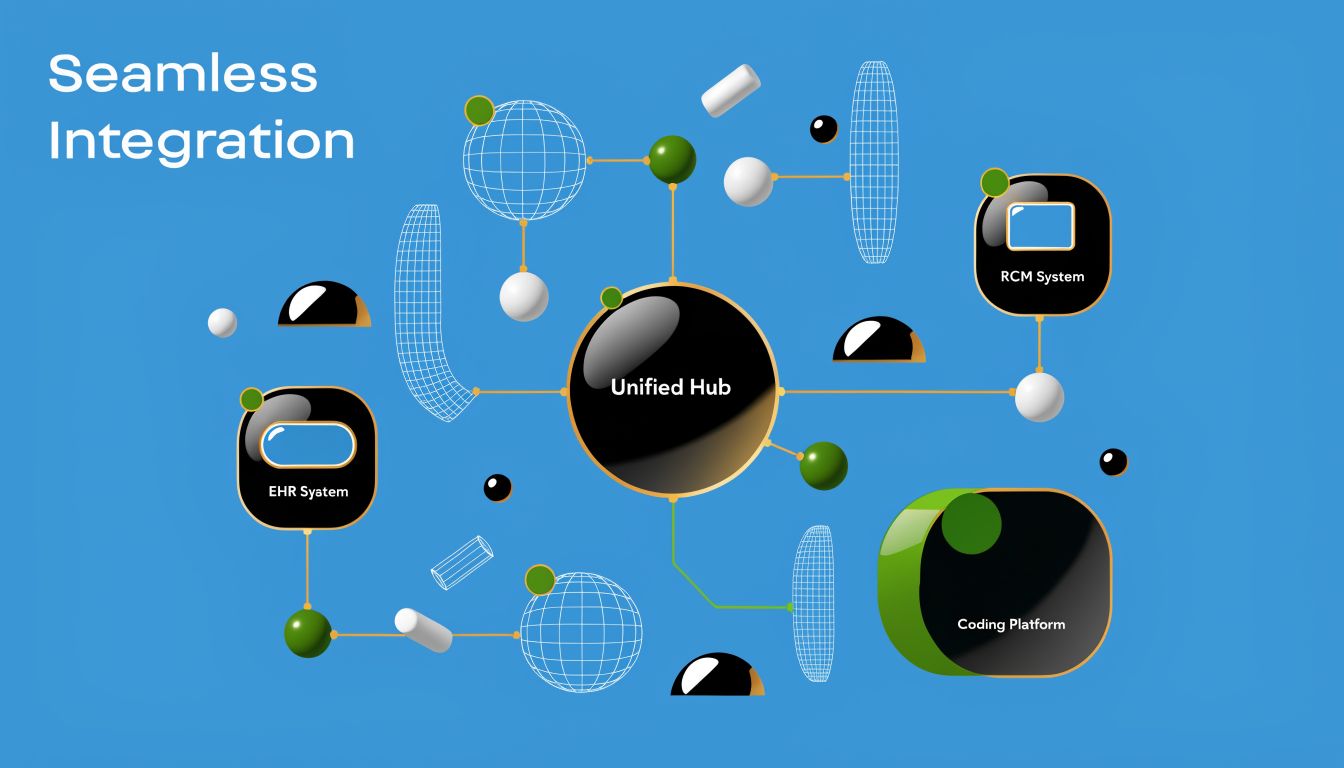
Implementation succeeds when leaders treat it as an operating model change, not a software install. Autonomous coding touches EHR workflows, coding teams, HIM, compliance, CDI, claims, and finance. If any one of those groups is excluded from design decisions, friction shows up quickly after launch.
Start with a narrow operational lane
The safest rollout usually begins with a defined use case. Hospitals often choose a specialty, encounter type, or documentation environment where chart patterns are reasonably stable and leaders can validate outcomes quickly.
That initial scope gives the organization room to answer the questions that matter most. Which charts can move straight through? Which require coder review? Where does the platform struggle because documentation is inconsistent? Those answers shape the broader deployment.
Build integration around workflow, not theory
Technical integration with Epic, Oracle Health, Cerner environments, billing platforms, and claims systems matters, but workflow design matters more. Data has to arrive in the right sequence. Coding decisions have to feed downstream teams without creating duplicate queues. Audit findings need to route back to operations in a form people can act on.
A clean implementation usually includes these design choices:
- Encounter routing rules: Define which charts are eligible for automation and which must be held for review.
- Role clarity: Coders, auditors, CDI staff, and compliance teams need distinct responsibilities in the future-state model.
- Exception handling: Staff should know exactly what happens when documentation is incomplete, contradictory, or insufficiently specific.
- Security governance: Access, data handling, and audit logs must align with the organization’s broader information governance model.
Change management is often the real bottleneck
The coding team has to trust the system enough to work with it. Physicians need to understand why documentation precision matters more, not less, in an automated environment. Finance leaders need regular reporting that translates technical performance into operational consequence.
That’s why the best implementations usually have a formal governance structure from day one. A steering group should include revenue cycle leadership, HIM, compliance, IT, and operational stakeholders from the pilot area.
If staff think autonomous coding was deployed to monitor them or replace them, adoption slows. If they understand that it removes routine chart burden and sharpens escalation, adoption tends to improve.
Scale only after workflow proof
Hospitals get into trouble when they move from pilot to enterprise rollout too quickly. Expansion should follow evidence. Once the organization sees stable quality, clear escalation behavior, and downstream improvements in claims and audits, scaling becomes a rational next step instead of a leap of faith.
How to Select the Right Autonomous Coding Partner
Choosing a vendor for autonomous medical coding and auditing services isn’t like buying a standard software module. You’re selecting a long-term operating partner that will influence coding logic, audit posture, workflow design, and financial reporting discipline.
That means the evaluation process needs to go beyond demo quality.
The scorecard leadership should use
Start with engine capability. Can the platform interpret unstructured documentation with enough nuance to support your specialty mix? Then move to governance. Does every code carry evidence and rationale that an internal or external auditor can follow?
After that, test the service model:
- Human review design: How does the vendor define high-risk charts, and who reviews them?
- Audit support: Can the partner help your team defend outputs during internal and external review?
- Operational fit: Does the workflow support your EHR and existing coding operations?
- Scalability: Can the model support enterprise volume without losing visibility or specialty specificity?
One useful differentiator is whether the vendor understands cross-border complexity. According to KLAS commentary on autonomous coding reality versus hype, many market guides still overlook how coding engines must be tuned for different national coding logics such as U.S. CMS frameworks versus ICD-10-CA. That gap matters for systems with international operations or payer arrangements that don’t fit a single domestic model.
Questions that reveal partner maturity
Ask vendors to show how they handle a difficult chart, not an easy one. Ask how model updates are governed when coding rules change. Ask how audit disagreements are resolved. Ask what reporting your CFO and compliance officer will receive in the first ninety days.
The right partner will answer with workflow, controls, and evidence. The wrong one will answer with marketing language.
A final standard is simple. If the vendor can’t explain how your hospital will preserve coding accuracy, audit traceability, and operational accountability at the same time, the platform isn’t ready for enterprise adoption.
GeBBS Healthcare Solutions can support hospitals and health systems that are evaluating autonomous coding as part of a broader revenue cycle strategy. Its work spans coding, auditing, AI-enabled workflow, and operational governance, which makes it a relevant partner for leadership teams that want automation tied to measurable RCM performance rather than treated as a standalone tool.